
Project · Results · Team · Related
Context
Buildings and construction account for roughly 40% of greenhouse gas emissions in the EU, but until recently there was no agreed quantification of how those emissions are distributed across the life cycle of the stock, nor of how different policy choices would change them by 2050. Without that, the revision of the Energy Performance of Buildings Directive would have been argued on assertion rather than evidence.
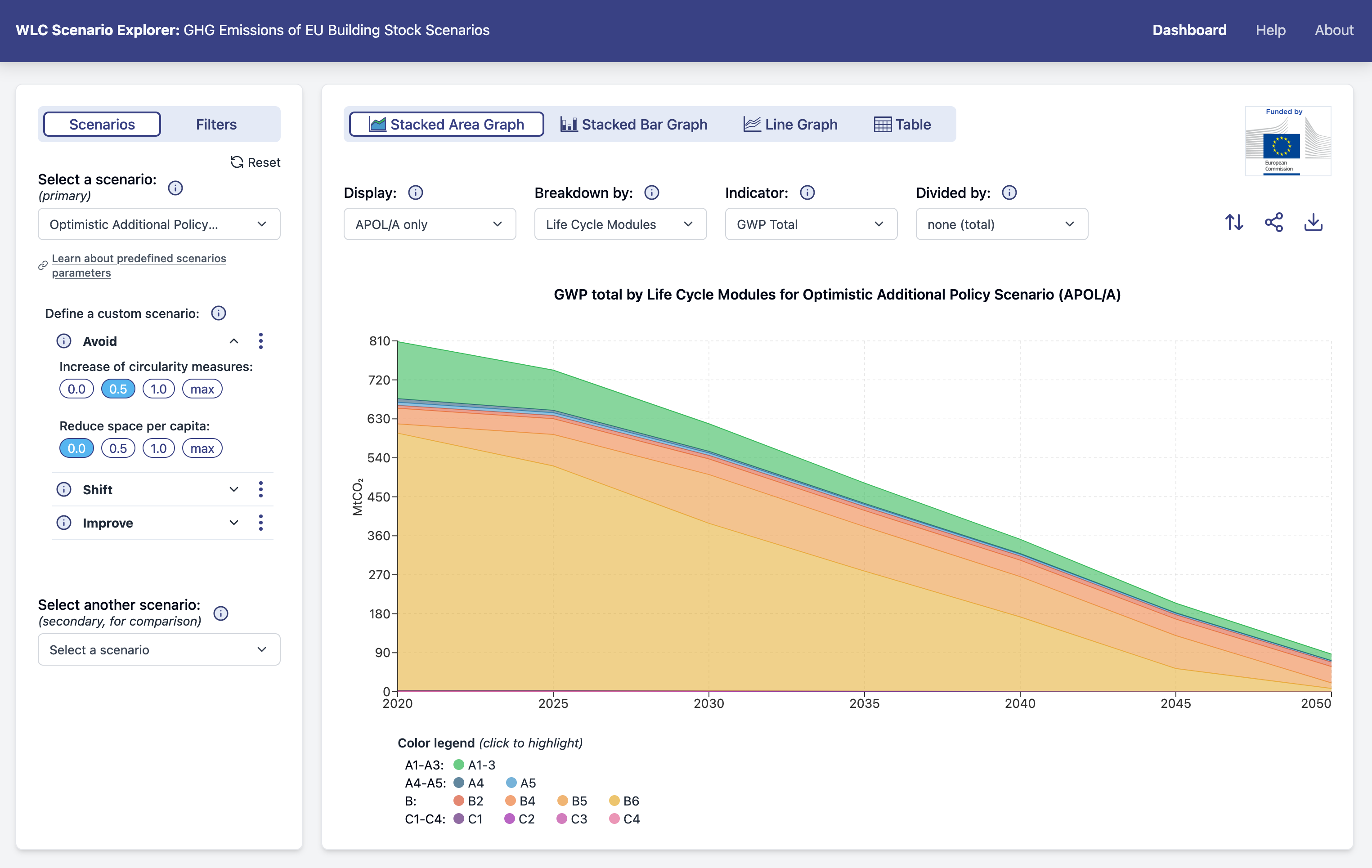
DG GROW commissioned the analysis to close that gap. We led the analytical work: a bottom-up model of the EU27 building stock, built from archetype buildings and harmonised material and energy flow data, run forward to 2050 under a set of policy scenarios, and assembled from open archetypes so that national teams could repeat it rather than start over.
Insights
- Embodied emissions are already about half the problem, and rising as a share. As operational performance improves under existing directives, the emissions locked into materials and construction become the dominant term. Any policy that targets only operational energy is aiming at a shrinking fraction.
- No single lever is sufficient. Reaching a trajectory consistent with EU climate targets requires radical reduction of operational emissions, a three- to fourfold increase in renovation rates, and material efficiency and decarbonisation of materials, together. Scenarios that pull only one of these levers fall well short.
- Removals are real but modest, and contested. Biogenic carbon storage in timber and mineral carbonation can contribute, but the magnitude depends heavily on accounting choices and on assumptions about forest carbon opportunity costs.
Impact
The results informed the evidence base for the revised Energy Performance of Buildings Directive, which now requires whole life carbon disclosure for all new buildings by 2030, and fed into the Commission’s wider work on the EU Taxonomy and construction products.
Results
- Analysis of results and implicationsFinal report · European Commission, 2025Open ↗
- Scenario modelling tool and underlying dataOpen ↗
Our experts

Partners
-
 RISE
Vienna, Austria
 KU LeuvenLeuven, Belgium
 TU GrazGraz, Austria
 RambollCopenhagen, Denmark
 BPIEBrussels, Belgium
 IIASALaxenburg, Austria
 Aalborg University BUILDCopenhagen, Denmark
 Politecnico di MilanoMilan, Italy
Client

Related
Posts
-
Urban Heat at COP31: context-specific pathways for EU buildings, 12 November
Martin presents the context-specific emissions pathways work in a shared 60-minute session on cooling and clean air, alongside submissions from Ecuador, India, Ethiopia and China.
-
Context-specific emissions pathways for EU buildings, in Nature Communications
New work with KU Leuven, TU Graz and IIASA on what different decarbonisation pathways mean for the European building stock to 2050.
Publications on this project
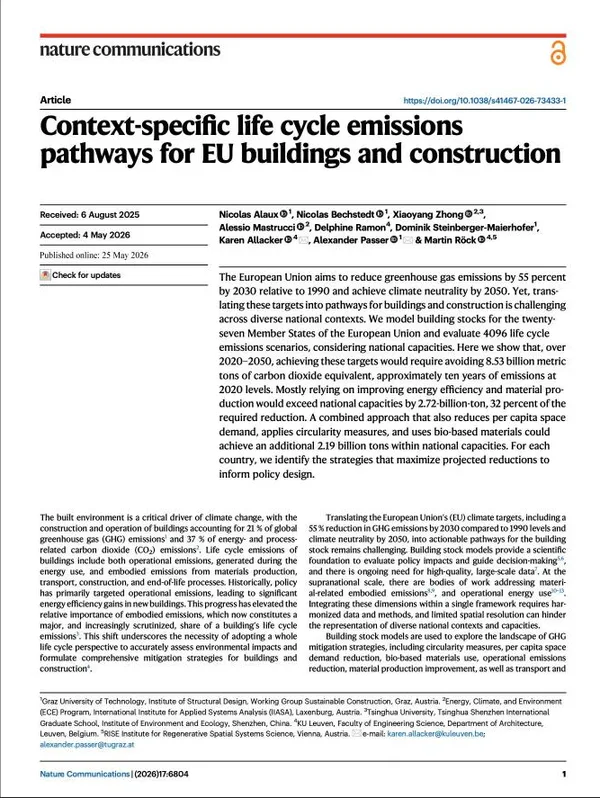
- Context-specific life cycle emissions pathways for EU buildings and construction
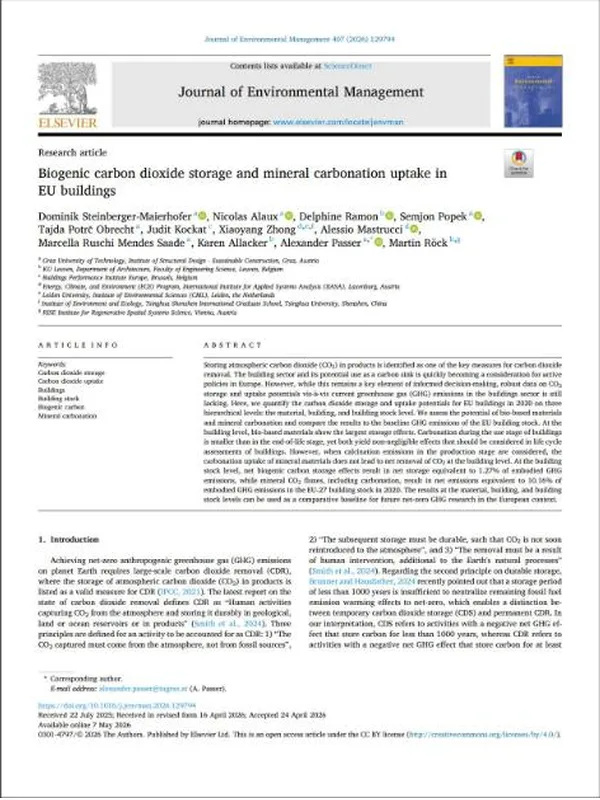
- Biogenic carbon dioxide storage and mineral carbonation uptake in EU buildings
- Climate impact of EU building materials: data compilation and statistical analysis of global warming potential in environmental product declarations
- Harmonised database on materials, energy flows and environmental impacts for building archetypes representing the EU27 building stock
- wlc-scenario-explorer: an open source tool for exploring building stock whole life cycle emission scenarios
- Analysis of life-cycle greenhouse gas emissions of EU buildings and construction - analysis of results and implications
- Whole-life greenhouse gas emission reduction and removal strategies for buildings
- SLiCE: an open building data model for scalable high-definition life cycle engineering, environmental hotspot analysis and dynamic impact assessment

Related projects
-
Re:Living - Scaling Renovation: Impact Hierarchy
Set out a hierarchy for action on Europe's housing - renovate first, extend second, build new last - and quantified what following it would save.
-
Global Whole Life Carbon Tracker for the Built Environment
Builds a global tracker of whole life carbon in construction, so progress can be measured against something.
-
Global Status Report for Buildings and Construction
The annual global stocktake of the sector's emissions and progress.
-
CollaborativeCarbon - Whole Life Carbon Assessments for Collaborative Housing across Europe
The first quantitative baseline for the whole life carbon of European collaborative housing - and the finding that it is structural material, not the collaborative model, that decides performance.
-
Supporting the Development of a Roadmap for the Reduction of Whole Life Carbon of Buildings
Provided the archetype modelling behind the EU's roadmap for bringing down whole life carbon.