
Project · Results · Team · Related
Context
Renovation is where the largest opportunity in the built environment sits, and it is the one that consistently fails to scale. It stays fragmented, gets reduced to a technical upgrade, and is argued for one building at a time.
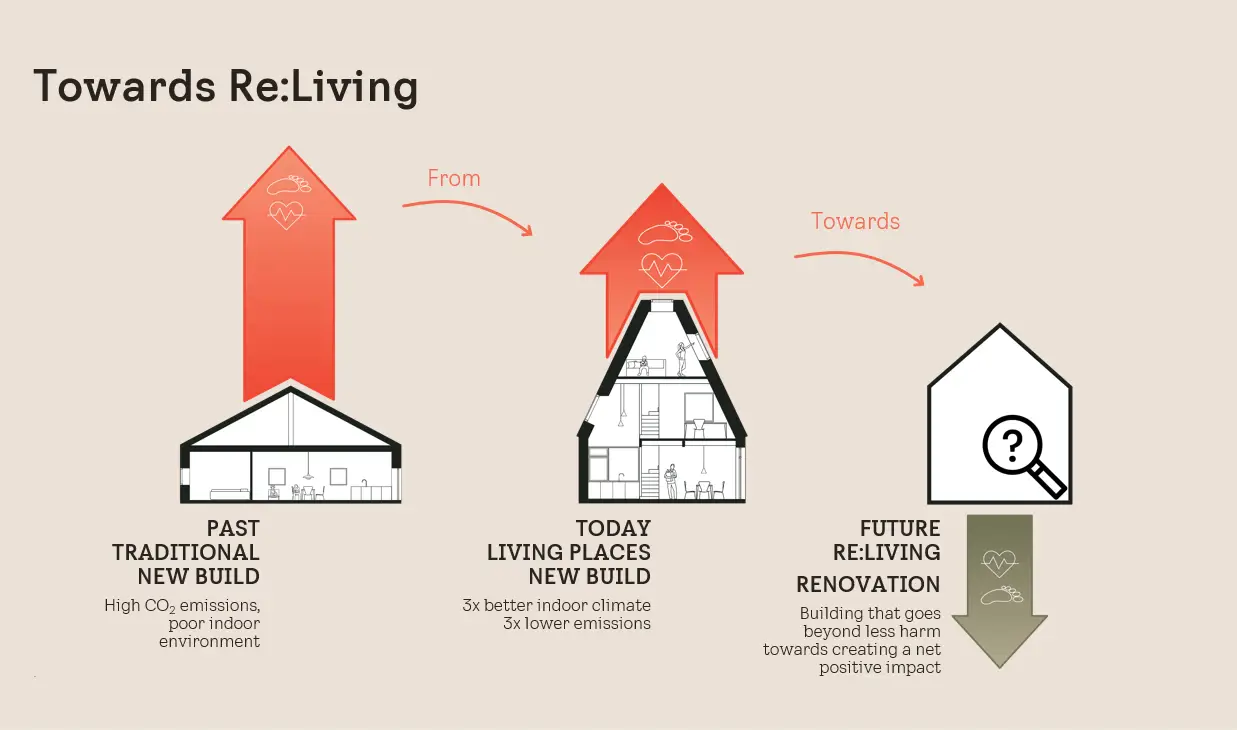
Re:Living, part of the VELUX Living Places programme, treats renovation instead as a systemic transformation - one that has to link environmental impact, health and affordability at once, because in Europe’s housing those three are the same problem seen from different sides.
RISE’s contribution is the part that turns the argument into something rankable: a hierarchy for action, and an estimate of what following it would actually be worth.
The argument
- The buildings are already here. Around 85% of today’s European building stock is expected to still be in use in 2050. Any strategy that treats new construction as the main instrument is working on the small end of the problem.
- The crises are one crisis. Climate and biodiversity, energy and resources, housing affordability, and unhealthy homes are usually addressed by separate policy. Over 40 million Europeans are in energy poverty, a third are exposed to indoor climate hazards, and house prices rose 53% between 2015 and 2024 - the same stock, failing on four counts.
- The space problem is a distribution problem. 20% of dwellings are underoccupied while 16.8% are overcrowded, and the EU needs more than two million additional homes a year - about a third more than it builds. Some of that demand can be met by using what exists differently rather than by building more of it.
Objectives
The paper’s central device, in strict order of preference:
- Renovate - first. Reclaim, reshape, refine, repurpose, resize. These unlock capacity and cut energy use for the least material. Reshaping an underused dwelling uses roughly five times less material than compact new build.
- Extend - where renovation cannot meet demand. Attic conversion, building up, building out.
- Build new - last resort. Compact construction, with biobased preferred over conventional mineral construction, which the paper treats as the reference case to move away from rather than the default.
Alongside it sits a four-quadrant reading of material intensity against emissions impact, which separates what looks like progress from what is: a measure can cut emissions and still sit in the wrong quadrant if it does so by pouring in material.
What following it would be worth
- Capacity. Using buildings better could unlock 50–107 million dwellings and 4–9 billion m² of floor area - housing for roughly 120–250 million people, without new land.
- Emissions. 3.9–19.1 billion tonnes CO₂e avoided over fifty years, which is 8–32% of annual building-sector whole life carbon and 2–11% of EU-wide annual emissions. About three quarters of that comes from renovation measures, and the renovation measures pay their carbon back in three to seven years.
- Material. 5.8–13 Gt avoided, roughly two years of total EU material consumption.
- Cost, where it has been tested. Some completed conversion projects delivered homes up to 20% cheaper than new construction.
What this is not
The quantification is a theoretical and technical potential, and the paper says so plainly. It does not model demographic change, local market dynamics or future grid decarbonisation, and it does not pretend the economic, social and regulatory barriers are small. The number is what is physically available if the hierarchy were followed - the argument is about how much is being left on the table, not about what will happen by itself.
Results
- The Housing We Need For The Future We WantGreen paper · VELUX Living Places, 3 July 2026 · with BPIE, No Objectives, RISE and ArteliaOpen ↗
- Re:Living on Living PlacesProject background and the four-stage approachOpen ↗
Our experts
-
 Barbara Droste-LuckmannHead of Office, Stakeholder and Communications ManagerRISE, GBDI
-
 Dr. Martin RöckFounding Director and Lead ScientistRISE, GBDI
Partners
-
 RISE
Vienna, Austria
 The VELUX GroupHørsholm, Denmark
 BPIEBrussels, Belgium
 No ObjectivesDenmark
 Artelia DenmarkCopenhagen, Denmark
the Re:Living experiment is being tested with IBA'27, DGJ Architektur and Transsolar
Client
Related
Publications on this project
Related projects
-
CollaborativeCarbon - Whole Life Carbon Assessments for Collaborative Housing across Europe
The first quantitative baseline for the whole life carbon of European collaborative housing - and the finding that it is structural material, not the collaborative model, that decides performance.
-
Analysis of Life Cycle Greenhouse Gas Emissions and Removals of EU Buildings and Construction
Quantified the baseline and the plausible futures for emissions and removals across the EU building stock to 2050.