

Context
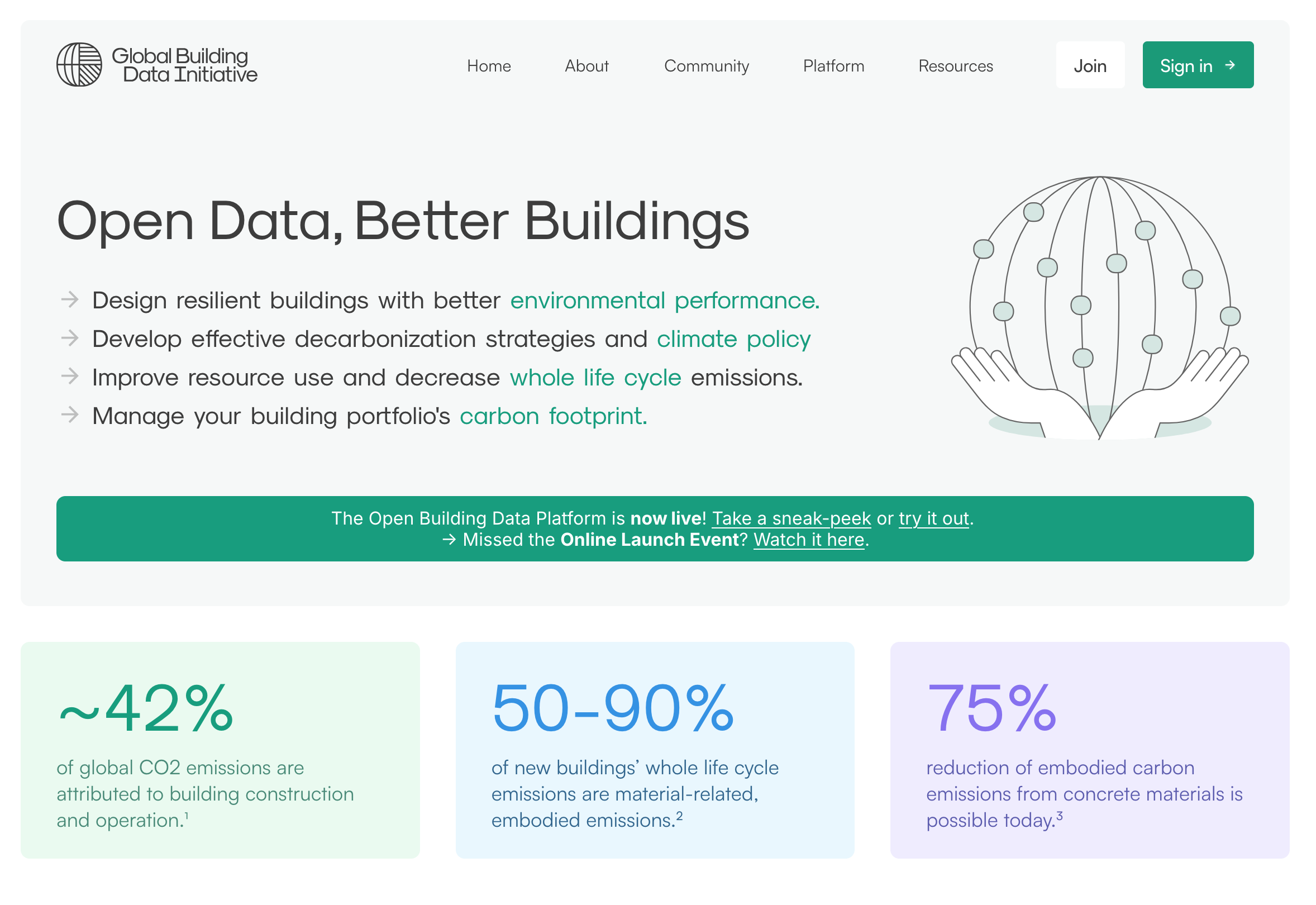
Building life cycle assessment has been done tens of thousands of times. Very little of it is comparable, and almost none of it is public. Every benchmark study starts by assembling its own dataset, which is why benchmarks disagree and why most countries still have none.
Insights
- Built an open data commons. A structured, openly licensed database of resource use and upfront embodied carbon for new buildings, designed so entries from different countries and tools can sit side by side.
- Agreed the minimum. What has to be recorded for a building assessment to be comparable with another - scope, units, reference area, data quality.
- Made contribution possible. Routes for national teams, researchers and industry to add their own data rather than only consume someone else’s.
Impact
GBDI outgrew the project that started it. It is now an association under Austrian law with its own governance, and it continues as a standing initiative rather than a funded piece of work.
In October 2026 it became a founding member of CLEAR, the Coalition for Life cycle Emissions Alignment and Reporting, convened by RICS to quantify where the leading carbon assessment methods diverge and then harmonise them. That work addresses the problem the database runs into from the other side: an open data commons is only as useful as the comparability of what goes into it.
More at gbdi.io.
Our experts
-
 Dr. Martin RöckFounding Director and Lead ScientistRISE, GBDI
-
 Dr. Nicole Di SantoSenior Scientist, WLCA and Digital Integrations LeadExtended team · GBDI, EPFL
-
 Dr. Zuhaib BatraSenior Scientist, Global Policy Lead: Energy and EmissionsExtended team · GBDI, EPFL
Partners


Client

Related
Posts
-
Two whole life carbon sessions at COP31, 16 November
Better data in the morning, what to do with it in the afternoon: two COP31 sessions on the gap between measuring carbon and managing it, the second presenting CLEAR.
-
CLEAR: a coalition to make whole life carbon numbers mean the same thing
RICS and founding members including GBDI have launched the Coalition for Life cycle Emissions Alignment and Reporting, to quantify where carbon assessment methods diverge and then harmonise them.
-
GBDI non-profit association founded
The Global Building Data Initiative has been established as a non-profit association under Austrian law, with RISE in a founding role.
-
Green procurement of low-carbon concrete - what came out of the Beijing seminar
Sixty participants from government, industry and research on how public procurement can pull low-carbon building materials into the market, and what China plans to put into procurement evaluation next.
-
Whole life carbon for India's building sector - GBDI webinar with IIT Bombay
Why whole life carbon matters for India's net-zero goals, what CCTS and CBAM mean for material supply chains, and which data and tools exist today.
-
Keynote at the CBPM Conference, Cape Town
On whole life cycle modelling for low-carbon, climate-resilient building stock - and on why there is no one pathway that fits every context.
-
A global buildings database, openly published
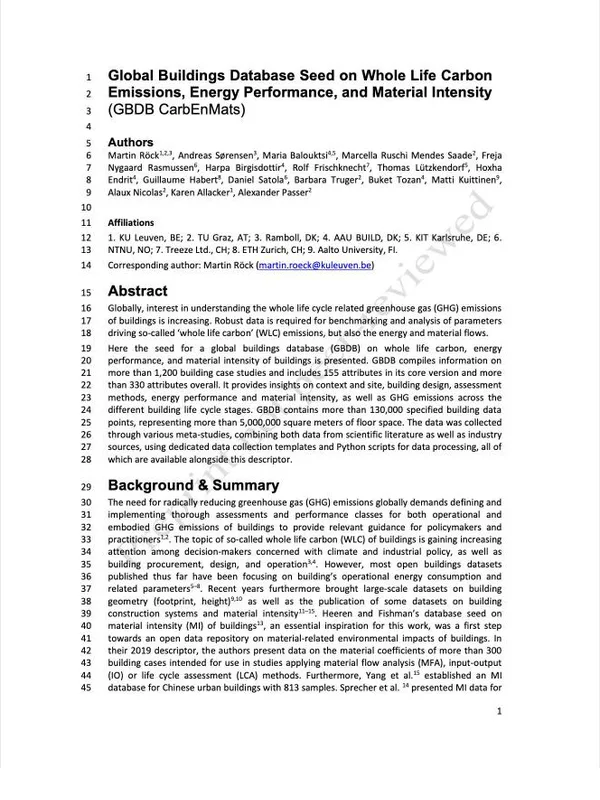
Whole life carbon, energy performance and material intensity for buildings worldwide - the dataset behind GBDI, released on Zenodo.
Publications on this project
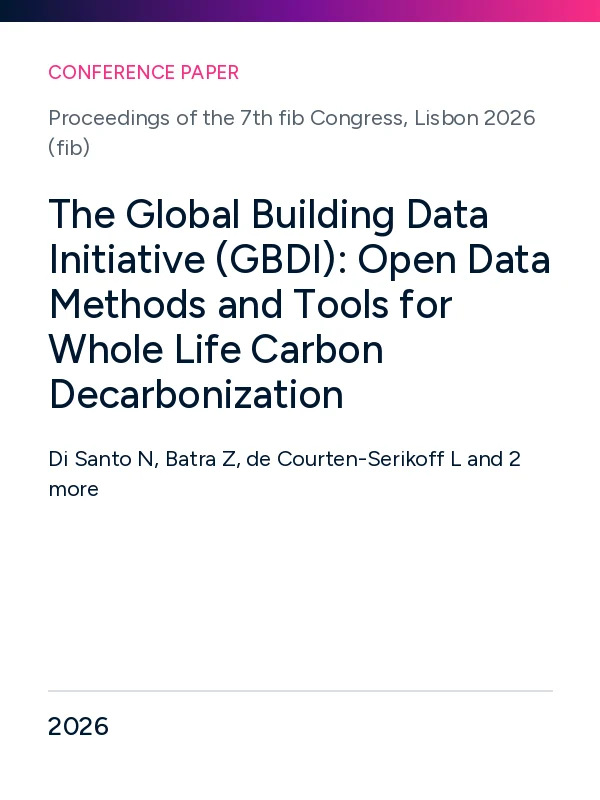
- The Global Building Data Initiative (GBDI): Open Data Methods and Tools for Whole Life Carbon Decarbonization
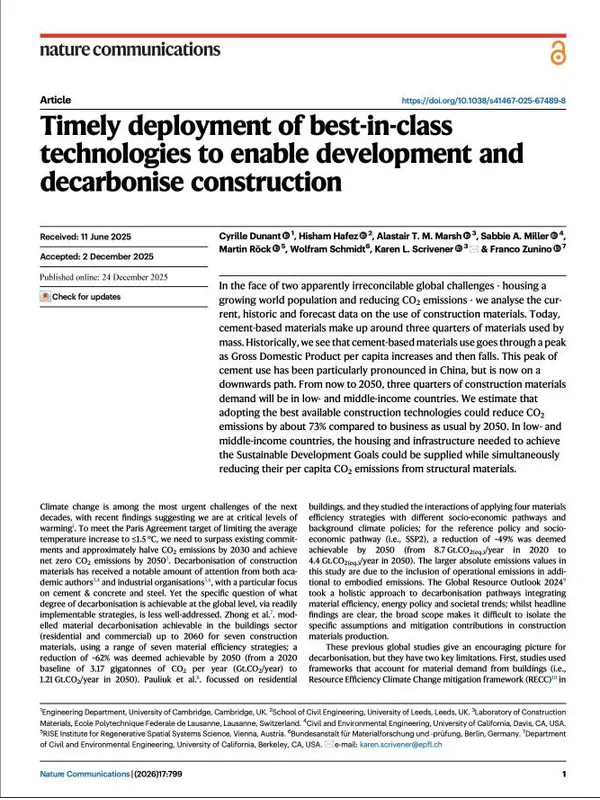
- Timely deployment of best-in-class technologies to enable development and decarbonise construction
- A global buildings database: whole life cycle GHG emissions, energy performance, and material intensity
Related projects
-
GBDI China and India Cooperation Incubator
Extends the global building data work into the two markets that will add the most floor area this century.
-
Global Whole Life Carbon Tracker for the Built Environment
Builds a global tracker of whole life carbon in construction, so progress can be measured against something.
-
Chile: whole life carbon tool and data harmonisation with OpenBDF
Aligns Chile's national whole life carbon tool and building database with the open global data format from the start, so the data stays comparable.