
Project · Results · Team · Related
Context
Demand for climate-friendly products is what will decide whether industry reaches climate neutrality by mid-century. Supply-side support can build the plants; only demand makes the case for running them.
The building sector is one of the largest consumers of basic materials such as cement and steel, which is precisely what qualifies it to go first. Parts of the construction industry are already working to create demand for near-zero and circular materials. Those efforts now need to be scaled, so that the appetite for climate-neutral materials is large and certain enough for producers to keep investing in the transition.
The sequence matters. Embodied carbon emissions in building materials have to be determined and made transparent first. Limit values on the CO₂ intensity of materials used in new construction can then be phased in, stimulating demand and clearing the barriers that new low-emission products run into. These demand-side measures should be coordinated across Germany and the EU with supply-side instruments such as Klimaschutzverträge, which address the other half of the problem.
This study, produced with Agora Industrie, ifeu and Ramboll, sets out what that policy framework could look like.
Insights
- Embodied carbon is now most of a new building’s footprint. Producing
steel, concrete and brick, and processing them on site, currently accounts
for up to 90% of the life cycle CO₂ emissions of a new building. In Germany
these embodied emissions came to roughly 73 million tonnes CO₂-equivalent in
- Reaching climate neutrality efficiently means avoiding almost all of them by 2045.
- Switching materials is what creates the business case for industry. Moving to climate-friendly building materials gives producers a long-term commercial basis for investing in near-zero production technology, which makes it a key to the industrial transition rather than a consequence of it. A cost-efficient and durable strategy pairs climate-neutral materials with circular and more efficient building practice: recycling and reusing materials, and shifting from mineral to renewable ones.
- The cost objection does not survive contact with the numbers. Near-zero steel and concrete still cost up to a third more than conventional material, but they raise construction costs only as much as ordinary non-climate decisions do, such as the choice of facade. Costs can reach parity with conventional materials by 2040 and fall below them by 2050.
- No single instrument is enough. Phasing in progressively stricter limit values, as the revised EU Energy Performance of Buildings Directive requires, is central. But cutting emissions substantially as early as 2030 also needs modernised building law, to create room and incentive for circular, climate-friendly construction.
Results
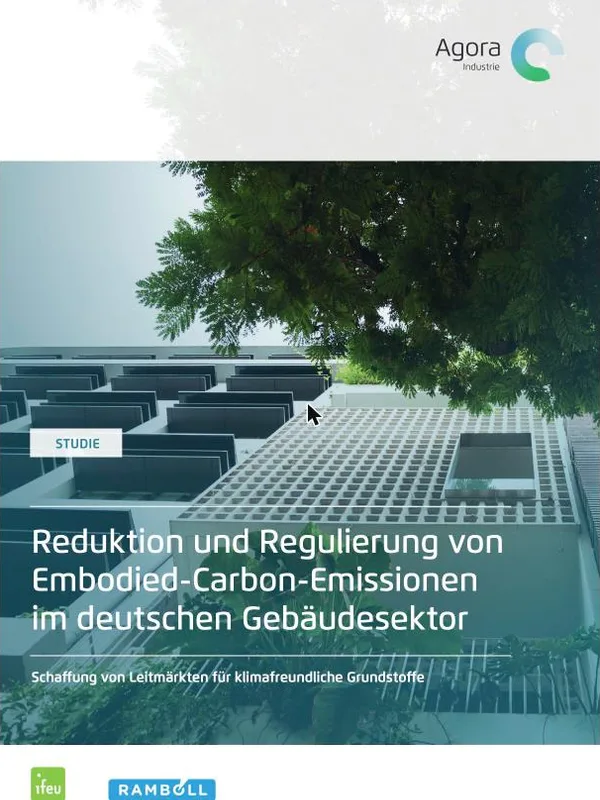
- Reduktion und Regulierung von Embodied-Carbon-Emissionen im deutschen GebäudesektorStudy, 95 pages · Agora Industrie, September 2024 (v1.2, November 2024) · GermanOpen ↗
- Publication page and figuresAll 33 figures available as PNG, EPS and PDF under CC BY 4.0Open ↗
Our experts

Partners
-
 RISE
Vienna, Austria
 Agora IndustrieBerlin, Germany
 ifeu - Institut für Energie- und UmweltforschungHeidelberg, Germany
 RambollCopenhagen, Denmark
Client
Related
Publications on this project
Related projects
-
Towards Embodied Carbon Benchmarks for the European Building Industry
Established a first European baseline for embodied carbon from real building data, and a budget-based way to set targets against it.